
A first-time founder with a spare weekend and few savings often assumes green means expensive. Practical eco friendly business ideas say otherwise: repair, upcycling and local services use used materials and skills, so they can earn before stock builds up.
If you already run a company and want to green it rather than start a new one, the guide on how to make a small business more sustainable covers changes to existing operations. This page is about choosing and testing a new venture.
What makes an eco business profitable
An eco-friendly business earns a profit the way any business does: customers pay more than the idea costs to deliver. The green angle adds a reason to choose you over a competitor. Chariot Energy’s small business sustainability guidance observes that more and more people want to do business with eco-friendly companies. A university campus roundup of sustainable businesses presents entrepreneurs who build sustainable solutions as running ventures that can be profitable as well as purposeful.
Both statements describe the direction of demand, not margins. Treat them as encouragement to test an idea, then rely on your own prices and costs to decide whether it pays. The table below separates three common assumptions from what the evidence supports.
| Common belief | What holds up | Planning use |
|---|---|---|
| You need new, specially sourced stock to be credible | Gently used or upcycled furniture is recommended over new, and used furniture costs less | Build the offer around secondhand inputs to keep startup spending down |
| Repair is a hobby, not a business | Learning to repair and upcycle bicycles is described as a valuable skill and a profitable business | Price repair as a paid service from the first job |
| An eco business must sell physical products | Natural-product cleaning and eco gardening, covering native planting, composting systems and pollinator-friendly gardens, are described as services | Services sell time and skill, so a first booking does not wait on a stock order |
These points draw on Chariot Energy’s sustainability ideas and Kidpreneurs’ eco-friendly business list.
Eco business ideas ranked by cost and speed to first revenue
The ranking below is a judgement about what each idea must buy or build before it can take its first payment. The lowest-barrier ideas sell skill and time. Next come ideas that turn cheap secondhand material into something sellable. Product lines that need new inventory, packaging and display come last. Your own skills and local market can reorder the list.
Service ideas: the fastest route to a first customer
- Eco cleaning service. Kidpreneurs describes a service built on homemade, natural cleaning products for local homes and businesses. It suits anyone with time, reliable habits and a neighbourhood to canvass. Check local rules on products and safety information before you advertise.
- Eco gardening service. The same source frames this as native planting, composting systems and pollinator-friendly gardens. It suits people who already know plants and want recurring local work. Seasonal demand is a reason to line up a second service for quiet months.
Both ideas need little more than tools, supplies and transport, so the main startup cost is your time. That is why they rank highest for speed.
Repair and upcycling: low spend, slower per sale
A repair business is the clearest case where skill replaces capital. Kidpreneurs says learning to repair and upcycle bicycles can be both a valuable skill and a profitable business. The customer already owns the item, so you carry little inventory risk. The limit is capacity: each job takes your own hours, so income grows only when you raise prices, add helpers or specialise.
Upcycling follows a similar logic with more creative freedom. The same source suggests creating clothing or accessories from upcycled materials, and Chariot Energy recommends gently used or upcycled furniture over new. Because used furniture costs less to acquire, the margin depends on your restoration skill and on selling at a price that covers your time. Every piece is a one-off, so choose this route if you enjoy variety and can accept uneven weekly income. If you prefer repeatable output, a product line may suit you better.
Product lines, refills and packaging: the highest upfront spend
Product businesses ask for inventory, display and packaging before they earn. Large brands show which selling points customers recognise. The SRH Haarlem campus roundup highlights Patagonia for building clothing and gear to last and so reduce replacements, Ecover for cleaning products made from natural, renewable resources, and Seventh Generation for recycled materials in its packaging. A small founder cannot copy their scale, but can borrow the principle: durability, renewable ingredients or recycled packaging can each be the reason a buyer picks your product.
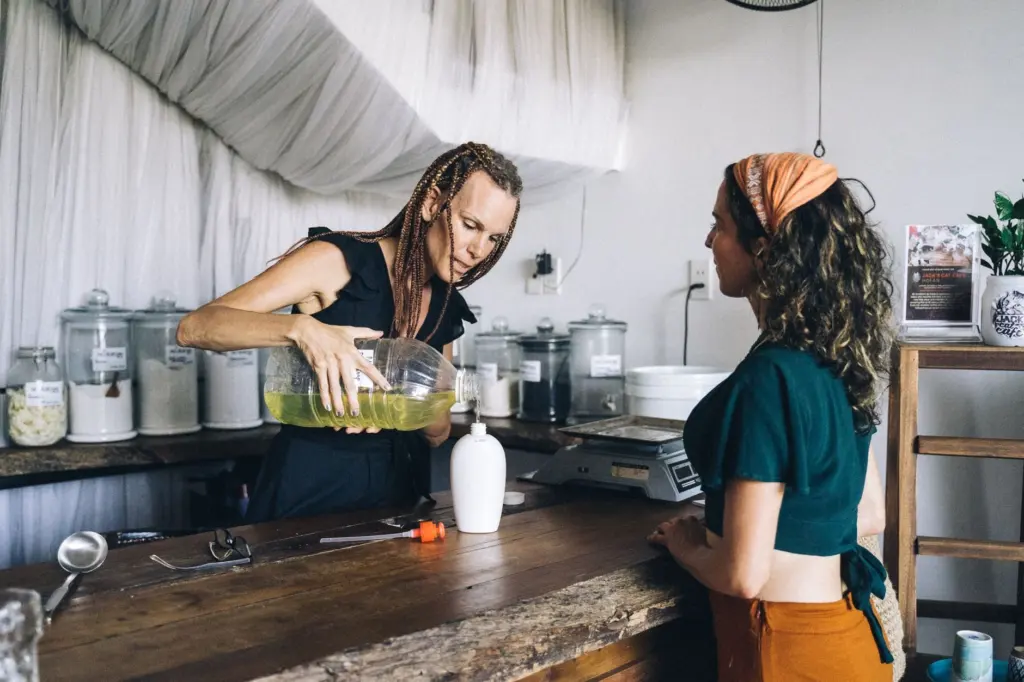
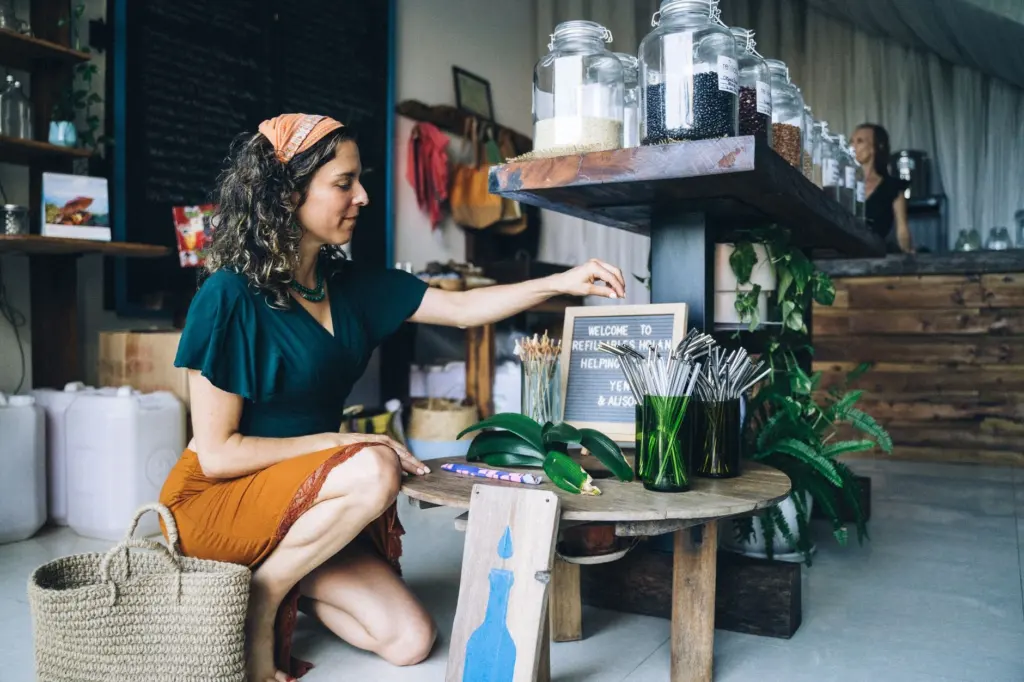
A refill or bulk-goods shop is a natural fit for this approach, because reusable containers are part of the offer and not an added cost. Start with a stall or pop-up before you commit to premises.
Shipping is part of the product. Chariot Energy points out that cardboard cannot be recycled with plastic tape still attached, so paper tape is a simple switch for mailed orders. Clothing sellers can go further with the packaging strategies in Sustainable Clothing Packaging: Practical Strategies To Cut Waste, Save Cost, And Win Customers In 2026 – Greencrowding.
What startup costs depend on
No single figure covers every eco business, because costs follow the idea. The main drivers are materials, tools, transport and packaging. Services and repair spend mostly on tools and travel. Upcycling spends on secondhand inputs and finishing supplies. Product lines spend on inventory and containers before the first sale.
The practical rule is to pick the idea whose main input you already own or can source used. Chariot Energy’s point that used furniture costs less than new generalises well. Every secondhand input lowers the amount you risk before you know whether customers will pay. Keep a running list of what you buy against what you earn, since a business that cannot show its costs cannot price properly.
Validating an idea before you commit
Validation means collecting evidence that strangers will pay your price, not that friends like the idea. Chariot Energy advises knowing where you stand before implementing anything. For a founder, that means an honest look at your skills, available hours and the competitors in your area before you buy tools or stock.
- Sell the smallest version. Take a pilot booking, run a stall or list a few finished pieces. A payment is stronger evidence than a compliment.
- Record what each sale costs you. Note the time, materials, travel and any advertising behind each customer, then compare that with what remains after direct costs. If little remains, change the price, the method or the idea.
- Ask buyers what to change. Their answers about price, convenience and quality show you what to adjust before you scale.
- Repeat before expanding. Hire help or buy equipment only after customers return or refer others.
Once the offer sells, What Is Green Marketing? The Practical Guide To Eco‑Friendly Brand Growth In 2026 – Greencrowding explains how to describe its environmental benefits to a wider audience.
Misunderstandings that waste money
- A long idea list is a plan. One public list at Global Stewards offers over ninety green business ideas, generated by ChatGPT. Lists show breadth, not demand in your town. Pick two or three that match your skills, then test them.
- Big sustainable brands are startup templates. Their examples show what customers value, such as durability or recycled packaging. They do not show what a one-person venture can afford. Borrow the selling point, not the scale.
- Green positioning replaces quality. Customers still compare price, reliability and convenience. The environmental benefit is the tiebreaker, so deliver the basics first.
- Higher spend means a stronger business. The ideas above that cost least to start can be the quickest to test, and you can add inventory later once demand is proven.
Frequently asked questions
| Question | Answer |
|---|---|
| Do customers actually want to buy from eco-friendly companies? | Chariot Energy says more and more people want to do business with eco-friendly companies. That supports testing an idea, but it gives no percentage, so confirm local demand with a pilot sale. |
| Can a young person start an eco business? | Yes. Kidpreneurs suggests that young entrepreneurs can create and sell crafts made from recycled materials, which keeps material costs low and lets them learn pricing on a small scale. |
| What kind of product could appeal to pet owners? | Kidpreneurs mentions eco-friendly pet products such as toys made from recycled materials and natural pet treats. Treat it as a product line, with the higher upfront spend that implies. |