
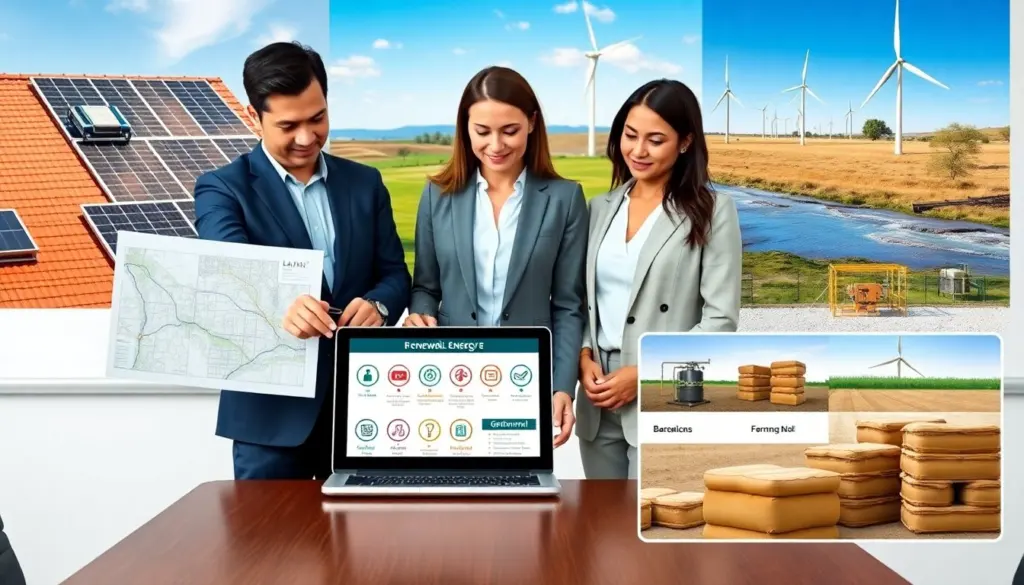
The article lists 5 types of renewable energy and explains practical uses for each. It defines simple benefits and common trade-offs. It helps readers compare options for homes and projects. It uses clear facts and direct advice. It avoids jargon and presents choices by cost, space, and local conditions. This expanded version adds practical decision steps, common pitfalls to avoid, and more actionable questions to help readers evaluate the five options for their specific circumstances. It keeps the same structure but gives extra detail so readers can move from general comparison to concrete next steps.
Key Takeaways
- Solar power offers low-maintenance, modular energy ideal for rooftops and scalable projects, making it a top renewable choice for many homes.
- Wind energy performs best in open, windy areas and can serve both large-scale farms and remote properties with turbines.
- Hydropower and geothermal provide reliable, stable baseload power but require specific site conditions like flowing water or geothermal heat sources.
- Biomass energy converts organic waste into dispatchable power but depends on steady fuel supply and environmental management.
- Choosing the right renewable energy depends on your energy needs, budget, location, and available resources, with hybrid systems offering balanced solutions.
Quick Snapshot: The Five Renewable Energy Types And Where They Fit
Solar power uses sunlight to make electricity. Solar panels convert light to electricity with no fuel. Solar works well on rooftops, farms, and in open fields. Solar suits homes, small businesses, and community projects. Solar is highly scalable: a single rooftop array can offset most household daytime use, while ground-mounted utility arrays serve entire neighborhoods. Wind power uses moving air to turn turbines. Wind farms produce large-scale electricity. Small turbines serve remote properties and farms. Wind fits open plains, coastal areas, and hilltops. Site-specific wind assessments help determine whether a small turbine or connection to a nearby wind farm is the better approach. Hydropower uses flowing water to spin turbines. Hydropower scales from large dams to small river turbines. Hydropower fits rivers, reservoirs, and irrigation canals. Small “run-of-river” systems can provide steady local power with lower civil works compared with large dams. Geothermal power uses heat from below the ground. Geothermal supplies steady heat and electricity. Geothermal fits volcanic zones and deep wells. For many communities, shallow geothermal (ground-source heat pumps) is a practical way to use geothermal energy for heating and cooling without deep drilling. Biomass energy burns organic material to create heat or gas. Biomass uses wood, agricultural residue, and purpose-grown crops. Biomass fits rural areas and facilities with steady feedstock. Biomass can be implemented at small scale (a boiler for a district heating system) or at larger scale (combined heat and power facilities) depending on available supply and local emissions rules.
The five types of renewable energy vary by cost, reliability, and land use. Solar and wind have low operating costs and fast deployment. Hydropower and geothermal provide stable baseload power. Biomass offers dispatchable energy but needs fuel supply. Each of the 5 types of renewable energy has local siting constraints. Each of the 5 types of renewable energy offers distinct benefits for different scales. In practice, communities and project developers weigh capital expenditure, ongoing operations, permitting complexity, and social acceptance when selecting between these options.
How Each Renewable Source Works, With Key Benefits And Trade-Offs
Solar panels contain photovoltaic cells that convert photons to electrons. Solar arrays generate power during daylight. Benefit: low maintenance and modular installation. Trade-off: output falls at night and with cloud cover. Solar panels require roof area or ground mounts. Additional considerations include tilt and orientation for maximum annual output, inverter selection for efficiency and safety, and whether to add battery storage to firm up supply. Wind turbines turn rotor blades that drive a generator. Large turbines generate megawatts. Benefit: high output at windy sites. Trade-off: noise, visual impact, and variable output. Wind turbines need setback distances and good wind speed. Developers also consider turbine size, wake effects in multi-turbine layouts, and access for maintenance and long-term blade replacement. Hydropower channels water through turbines to make torque. Hydropower can store energy with pumped storage. Benefit: continuous output and storage potential. Trade-off: river ecosystem impacts and high capital cost. Hydropower requires reliable water flow and civil works. Permitting often includes environmental impact studies, fish passage solutions, and sediment management planning. Geothermal taps hot rock or fluid to run turbines or heat exchangers. Geothermal delivers round-the-clock power with small land footprint. Benefit: stable baseload and long plant life. Trade-off: high drilling cost and site-specific geology. Geothermal needs resource testing and proper wells. Developers evaluate reservoir temperature, permeability, and the risk of induced seismicity when planning projects. Biomass converts organic matter through combustion or gasification. Biomass can produce heat, electricity, or fuels. Benefit: dispatchable power and use of waste streams. Trade-off: emissions, transport needs, and supply logistics. Biomass projects require secure feedstock sourcing and air-quality controls. Life-cycle assessments help determine whether a biomass option reduces greenhouse gas emissions relative to fossil alternatives, and combustion systems need emissions controls for particulates and NOx.
Each of the 5 types of renewable energy interacts with the grid differently. Solar and wind need grid flexibility or storage to match supply and demand. Grid-scale batteries, demand response, and flexible natural gas peakers (where available) are common complements. Hydropower and geothermal reduce the need for backup power and can support frequency and voltage control. Biomass can operate as a flexible backup, providing dispatchable ramps when intermittent sources drop. Each project requires a site assessment, permitting, and cost analysis. Each project also faces local policy and incentive differences that change economics, such as net metering rules for solar, feed-in tariffs for wind or biomass, and renewable energy credits that can affect revenue streams.
How To Choose The Right Renewable Energy For Your Home Or Project
They should list goals before choosing among the 5 types of renewable energy. They should state whether they need electricity, heat, or fuel. They should quantify budget and available land. For a rooftop homeowner, solar often ranks first. Solar panels fit most roofs and scale by budget. Consider roof age and orientation, shading from nearby trees or buildings, and whether the electrical panel and roof structure need upgrades. For a property with steady wind, wind turbines can supply large shares of demand. Small turbines are most cost-effective where average wind speeds are consistently high; otherwise community-scale or utility wind may be the better option. For a riverside site, hydropower can deliver steady energy if flow is reliable. Check seasonal flow variability, environmental requirements, and access for construction. For a site with hot underground resources, geothermal can provide heat and power. For many homeowners and small campuses, ground-source heat pumps provide efficient heating and cooling with lower permitting complexity than deep geothermal. For farms and factories with organic waste, biomass can convert waste to energy. Evaluate feedstock availability, transport distances, and local air-quality rules.
They should compare upfront cost, operating cost, and payback time for each of the 5 types of renewable energy. They should check local incentives and utility programs. They should get site-specific resource data such as solar irradiance, wind speed, and water flow. They should review permitting timelines and community rules. They should consider hybrid designs that combine two of the 5 types of renewable energy. For example, solar plus battery reduces variability. Solar plus biomass gives seasonal balance. Pairing solar with small hydro or battery systems can reduce the need for grid upgrades. In larger projects, combining wind with storage or demand-side management can smooth output and increase capacity value.
They should plan maintenance, fuel supply, and grid connection early. They should get multiple quotes and ask for modeled output, expected degradation, and warranty terms. They should verify installer credentials and local references. They should factor in resale value and insurance. They should run a simple cost per kilowatt-hour estimate for each of the 5 types of renewable energy. Consider creating a short decision checklist: 1) What energy services do I need (electricity, heat, firm capacity)? 2) What resources are on site (sun, wind, water, geothermal heat, biomass feedstock)? 3) What is my available budget and financing options? 4) What are permitting and timeline constraints? 5) What maintenance and operational commitments can I meet? Use answers to narrow to one or two viable options, then get professional resource assessments and proposals. Ultimately, choose the option that meets your goals, fits your site, and stays within budget while aligning with local regulations and long-term energy plans.