
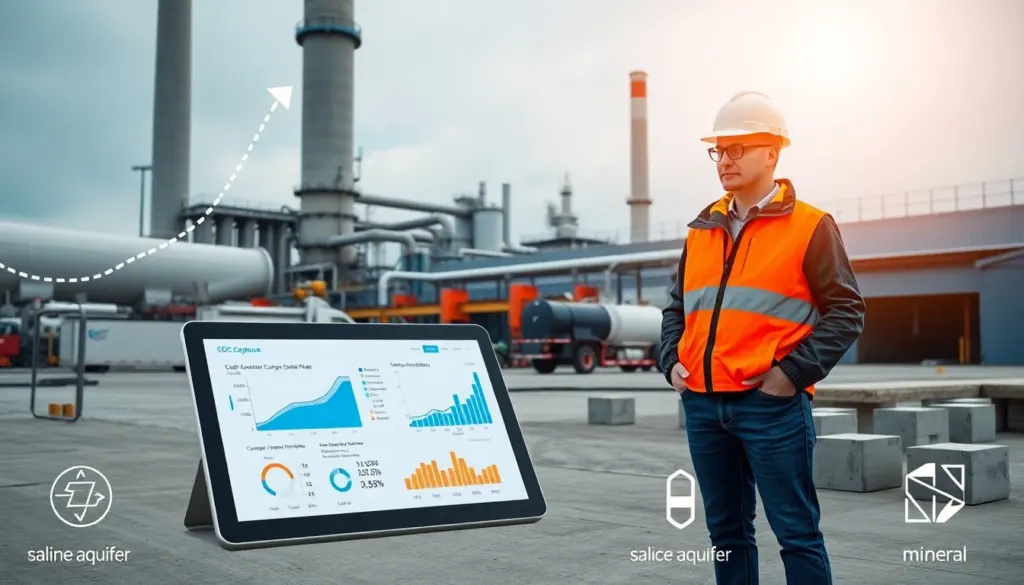
Cement carbon capture can cut emissions from concrete production quickly. This article explains why cement emits so much CO₂. It outlines capture options, storage choices, costs, and clear deployment steps. The text keeps language simple and factual so decision makers can act fast.
Key Takeaways
- Cement production emits significant CO₂ from both fuel combustion and calcination, making cement carbon capture essential for emission reduction.
- Post-combustion capture using solvents and sorbents offers a practical retrofit solution for cement plants to reduce CO₂ emissions effectively.
- Captured CO₂ can be permanently stored in geological formations or utilized in cement curing and chemical production, balancing scale and environmental benefits.
- Implementing cement carbon capture involves increased costs and energy use, but policy incentives like carbon pricing and subsidies can improve financial viability.
- Cement producers should follow a clear roadmap including emissions auditing, pilot testing, securing CO₂ transport and storage, and staff training to deploy carbon capture successfully.
Why Cement Produces So Much CO₂
Cement production releases CO₂ from two sources. First, burning fuel heats kilns. Second, calcination drives chemical CO₂ from limestone. The kiln fuel causes direct combustion emissions. The calcination reaction removes CO₂ from calcium carbonate and creates clinker. The process emits roughly 0.5 to 0.7 tonnes CO₂ per tonne of cement from calcination alone. Industry energy use adds another 0.2 to 0.4 tonnes. These combined sources make cement a high-emission industry and create a clear need for cement carbon capture.
Beyond the basic mass balance, plant design and operation influence emissions intensity. Older kilns, inefficient heat recovery, high clinker-to-cement ratios, and use of carbon-heavy fuels all raise the baseline. Geographic factors such as access to low‑carbon electricity, proximity to suitable storage sites, and local regulatory frameworks also shape the feasibility and cost of capture. Understanding these drivers at the plant level is the first step toward deploying effective cement carbon capture strategies.
Overview Of Carbon Capture Options For Cement Plants
Plants can capture CO₂ at different process points. They can install post-combustion systems on flue gas. They can change the process with oxy‑fuel or pre‑combustion steps. They can alter calcination using electric or alternative calciner designs. Each option changes capture rate, cost, and energy demand. Operators must compare retrofit ease, plant footprint, and integration with downstream CO₂ handling. The choice depends on plant age, fuel type, and access to storage or utilization markets. All paths can use cement carbon capture to cut emissions significantly.
Each technology family has trade‑offs. Post‑combustion options are generally lower‑risk for retrofit but incur parasitic energy loads and require downstream CO₂ conditioning. Oxy‑fuel combustion simplifies CO₂ purification but requires large air separation units and may need major kiln changes. Innovative approaches such as electrified calciners or indirect calcination aim to eliminate process emissions at source but are at earlier commercial stages and may require changes to raw material handling and kiln chemistry. A thorough technology screening that includes lifecycle impacts, footprint, and integration complexity is essential when comparing options for cement carbon capture.
Post‑Combustion Capture: Solvents, Sorbents, And Retrofit Paths
Post‑combustion systems remove CO₂ from flue gas after the kiln. Solvent scrubbers use solvents that absorb CO₂ and then release it when heated. Sorbent systems use solid materials that bind CO₂ and release it with temperature or pressure swings. Plants can retrofit these systems to existing stacks with moderate downtime. They can stage retrofits by unit to spread capital cost. They must add heat for solvent regeneration, which raises energy use. They must also plan for CO₂ purification and dehydration before transport or storage. These steps make post‑combustion a practical cement carbon capture route.
Designing a retrofit requires detailed flue gas characterization, space and utility assessments, and integration with process control systems. Key integration tasks include routing flue gas to capture trains, providing low‑grade heat for solvent regeneration (often via heat recovery or auxiliary boilers), and managing additional maintenance burdens. Sorbent systems may offer lower regeneration temperatures or modular deployment but bring different handling and lifetime considerations. For many producers, staged post‑combustion retrofits represent the fastest path to large‑scale CO₂ removal while keeping plant downtime and capital risk manageable.
Storage, Utilization, And Permanence: Where Captured CO₂ Goes
Captured CO₂ can go to storage or use. Storage options include deep saline aquifers and depleted oil and gas fields. Operators inject CO₂ and monitor pressure and leakage risk. Use options convert CO₂ into chemicals, fuels, or mineralized carbonates. Cement plants can use CO₂ to cure concrete and lock it into the matrix. Mineralization offers permanence by forming stable carbonates. Each route has trade‑offs in scale, revenue, and permanence. Project planners must choose pathways that align with local geology and market demand for cement carbon capture.
Deployers should evaluate the matching of capture volumes to available storage or utilization sinks. Geological storage offers high capacity and permanence but requires transport infrastructure and regulatory permitting. Utilization pathways such as concrete curing or feedstock for chemicals can create value streams but are often limited by market scale or product standards. Mineralization, either on‑site or at nearby facilities, provides a durable sink that can be integrated with cement production chains. Robust monitoring, reporting, and verification (MRV) frameworks are needed across all pathways to ensure environmental integrity and public acceptance.
Cost, Energy Penalties, And Policy Drivers For Adoption
Capture adds capital and operating costs to cement production. The energy penalty increases fuel or electricity needs for regeneration and compression. These costs commonly raise production cost per tonne of cement. Policy tools can change that math. Carbon pricing, direct subsidies, and tax credits lower net cost and speed deployment. Regulations can mandate capture on new plants or set performance standards. Market demand for low‑carbon cement can create price premiums. Together, these measures make cement carbon capture financially viable in many regions.
Financial planning should include sensitivity analyses for energy prices, carbon costs, and availability of incentives. Costs are influenced by capture rate targets, plant scale, and choices between on‑site versus shared transport and storage infrastructure. Public‑private partnerships and cluster approaches—where several industrial emitters share capture, transport, and storage assets—can reduce per‑project costs and accelerate deployment. Importantly, lifecycle accounting that includes avoided emissions from durable utilization or permanent storage strengthens the investment case for cement carbon capture under many policy regimes.
Roadmap For Cement Producers: Practical Steps To Deploy CCS
Producers should start with measurement and planning. They should audit emissions and map CO₂ sources. They should run pilot projects on one kiln to validate capture technology. They should secure transport and storage contracts or local utilization partners. They should seek public funding or carbon credits to lower upfront cost. They should scale incrementally and standardize designs across plants. They should train staff for operation and maintenance. Following these steps lets producers deploy cement carbon capture steadily and reduce emissions on a clear timeline.
A practical roadmap includes: (1) baseline emissions measurement and feasibility screening, (2) technology selection and front‑end engineering design, (3) pilot and demonstration deployments to de‑risk scaling, (4) securing offtake, transport, and storage arrangements, and (5) phased commercial roll‑out with continuous performance monitoring. Complementary actions—engaging regulators early, aligning with local stakeholders, and investing in workforce skills—reduce delays and increase the likelihood of successful long‑term operation. By following this staged approach, cement producers can integrate cement carbon capture into broader decarbonization strategies while managing cost, risk, and operational continuity.